2026 has taken us from the Human Rights Council in Geneva to Women Deliver in Melbourne, making one case in every room: there is no gender equality without equality in family law. Here is what we have been up to so far.
Making the case for reform at #HRC62
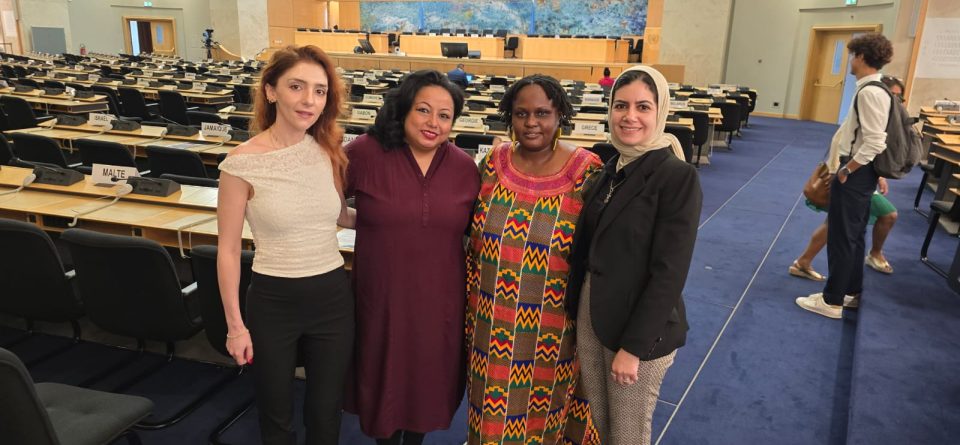
We recently spent a week at the 62nd session of the Human Rights Council in June, working alongside partners, allies and advocates to ensure that family rights law and the reforms of discriminatory laws and practices are included in the global human rights conversation. These issues have, in the past, been left out, regarded as too sensitive, too personal, or too complicated to address, and throughout our interventions and activities we made the case for inclusion of family law as a crucial part of the gender equality and human rights agenda.
On 24 June, the Council held its annual full-day discussion on the human rights of women, focused this year on domestic violence. Campaign Manager Hyshyama Hamin, took the floor on behalf of our coalition, telling the story of Salma, a 16-year-old girl in Sri Lanka’s Eastern Province.Salma was taken out of school and married to a 27-year-old man. Under the Muslim Marriage and Divorce Act, there is no minimum age for marriage and no requirement for the bride’s written consent or her presence at her own wedding. Her husband was violent from the start. She was hospitalised twice, the second time while nine months pregnant, and she lost her baby. When she sought maintenance, the Quazi awarded her about $4 a month. Her divorce took over two years. Her husband could have obtained his in a day.
Salma’s story highlighted the real harms caused by laws that fail to protect women and girls, and the system that refused to address it. In contrast, Hyshyama also shared the case studies which show the positive change which resulted from successful reforms around the world. In Mexico, stronger divorce laws reduced intimate partner violence. In India, the Hindu Succession Amendment Act gave women equal rights to inherit land and produced measurable reductions in violence. In Egypt, the introduction of Khul, allowing women to file for unilateral no-fault divorce, was followed by a drop in domestic abuse. Having made this strong case for reform, Hyshyama closed her intervention with a challenge to the decision makers assembled to hear testimonies from around the world.
Watch Hyshyama’s intervention here: https://www.youtube.com/embed/MpWSyupGSaA?si=o-Qs9O1YHrTQOsaw
“Your excellencies, the floor is yours, and the responsibility”
The following day we hosted Reclaiming Family for Gender Equality and Human Rights with Act Church of Sweden, ACT Alliance, GIN-SOGIE and the Nordic Advocacy Consortium, sponsored by Colombia, Sweden and the UN Working Group on Discrimination Against Women and Girls. The conversation turned on how narrow appeals to “family values” are being used to block progress on gender equality and sexual and reproductive rights, and why the family is a space we should be contesting rather than conceding.
That afternoon, the Hurra Coalition on family laws in the Arab States brought together voices from Arab states to make a related argument in a harder context. Where conflict and economic crisis dominate, gender equality is routinely deferred in the name of stability. Family law reform is not a luxury for peacetime but a prerequisite for recovery and for women’s economic security.
Outcomes on family laws in Secretary General’s report and Agreed Conclusions
The GCEFL expert paper “From Discrimination to Justice: Reforming Family Laws to Achieve Equality” was cited in a report by the UN Secretary-General, “Ensuring and strengthening access to justice for all women and girls, including by promoting inclusive and equitable legal systems, eliminating discriminatory laws, policies and practices, and addressing structural barriers” published ahead of #CSW70, which included a strong emphasis on family law in the legal frameworks section.
At #CSW70 itself in March, member states adopted Agreed Conclusions that include a call to promote comprehensive legislative review to identify and amend discriminatory provisions with direct reference to family laws, as well as a reference to eliminating all forms of discrimination in all matters relating to family relations. GCEFL through Coordinating Committee members had provided inputs on family law reform into the draft Agreed Conclusions of CSW70 before the session.
The GCEFL also hosted a side event at CSW70 titled ‘Envisioning Equality: The Case for Egalitarian Family Law Reform’. It was co-sponsored by the Government of Sweden, UN Working Group on Discrimination Against Women and Girls and UN Women. The side event featured a national member from Legal Aid Society Pakistan as a speaker, but unfortunately due to travel restrictions she was unable to be physically present. However, we were able to adapt and ensure her virtual participation. The side event was well attended, with 75 participants. Swedish and Kenyan government representatives gave opening remarks, and shared about progressive family law reforms and how they benefitted women and families.
GCEFL also collaborated with and co-sponsored a CSW70 side event organised by global member Fos Feminista titled ‘Leveraging Family Law Reform and Family-Oriented Policies to Advance Sexual and Reproductive Health and Rights (SRHR) and Access to Justice’. This side event was co-sponsored by the Government of Ireland. It was attended by 60 participants, mostly from the Fòs Feminista network of SRHR advocates, and it was the first time that a sister movement on diversity of families – #ForAllFamilies campaign – held an event on family laws. This is evidence that GCEFL’s advocacy on family laws is also spreading to adjacent movements working on SRHR and other related issues.
Women Deliver 2026: A global feminist gathering
Earlier, in May, the Global Campaign worked with Fos Feminista to co-host a side event at Women Deliver in Melbourne, Australia. Our side event took the form of an Intersections Lab, where we invited participants to explore the ways family law affects sexual and reproductive health rights (SRHR) and other issues affecting the human rights and equality of women and girls. We were excited to see participants from across multiple regions, issue areas and from diverse feminist movements learning that “family” can and should be a powerful site for feminist resistance. Together, we also explored the ways the feminist movement can counter an increasing global backlash against human rights and equality.
An evidence base for reform
The World Bank’s Women, Business and the Law Division recently recenly published their latest briefing paper “Unlocking Women’s Economic Rights through Family Law Reform: Lessons from Case Studies across Five Regions”, co-written by GCEFL Campaign Manager Hyshyama Hamin, Equality Now’s Antonia Kirkland and Women, Business and the Law’s Julia C Braunmiller . This Policy Brief draws on case studies from Chile, Kenya, Malaysia, Morocco, and Nepal to show the impact of discriminatory family law on women’s economic opportunities, and makes the case for accelerating family law reform efforts to ensure women’s economic rights and participation.
We are excited to be continuing our collaboration with Women, Business and the Law, and to see the business case for family law reform under the spotlight once again.